


 en-AE


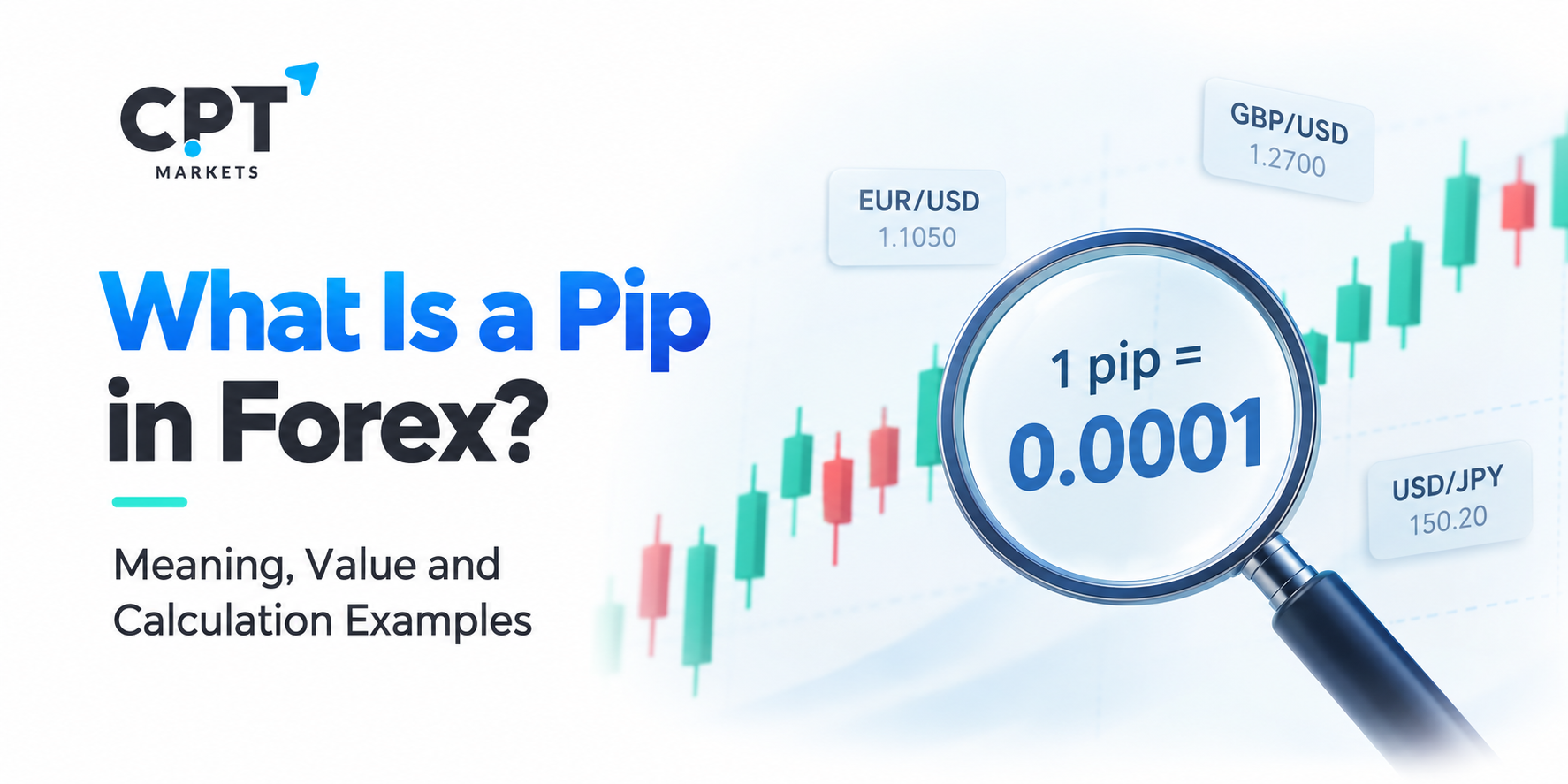
A pip is a standard unit used to measure currency-price movements in forex. For most currency pairs, one pip equals 0.0001 of the quoted price, while pairs involving the Japanese yen generally use 0.01. Pip value depends on the currency pair, trade size and account currency.
What Is a Pip in Forex?
A pip is a unit used to measure changes in the exchange rate of a currency pair. Instead of describing a small price movement as a long decimal change, forex traders can express it in pips.
For example, if EUR/USD moves from 1.1000 to 1.1010, the pair has risen by 10 pips. If it falls from 1.1000 to 1.0980, it has declined by 20 pips.
For most major, minor and cross-currency pairs, one pip is the fourth decimal place:
1 pip = 0.0001
However, currency pairs involving the Japanese yen generally use the second decimal place:
1 pip = 0.01
The exact way a trading platform displays prices can vary. Some platforms quote currencies to an additional decimal place, often called a pipette or fractional pip. Therefore, traders should check the instrument's quotation format before calculating a position's exact value.
Why Are Pips Important in Forex Trading?
Pips provide a common way to describe price movements, trading costs and potential profit or loss.
For example, saying that EUR/USD moved 35 pips gives traders a concise measurement of the move regardless of whether the position was large or small. Similarly, a spread may be expressed in pips, while a stop-loss distance can be defined by the number of pips between the entry and exit levels.
However, a pip movement is not the same as a monetary gain or loss. The financial value of one pip depends on the position size and, when applicable, the exchange rate between the quote currency and the account currency.
That distinction is important. Two positions can experience the same 20-pip movement but produce different monetary results because their trade sizes are different.
How Much Is One Pip Worth?
The value of one pip depends primarily on three factors:
- Currency pair
- Position size or lot size
- Account currency
For a currency pair where the quote currency is the same as the account currency, the basic calculation is relatively straightforward.
Basic pip-value formula:
Pip value = Position size × Pip size
100,000 × 0.0001 = USD 10 per pip
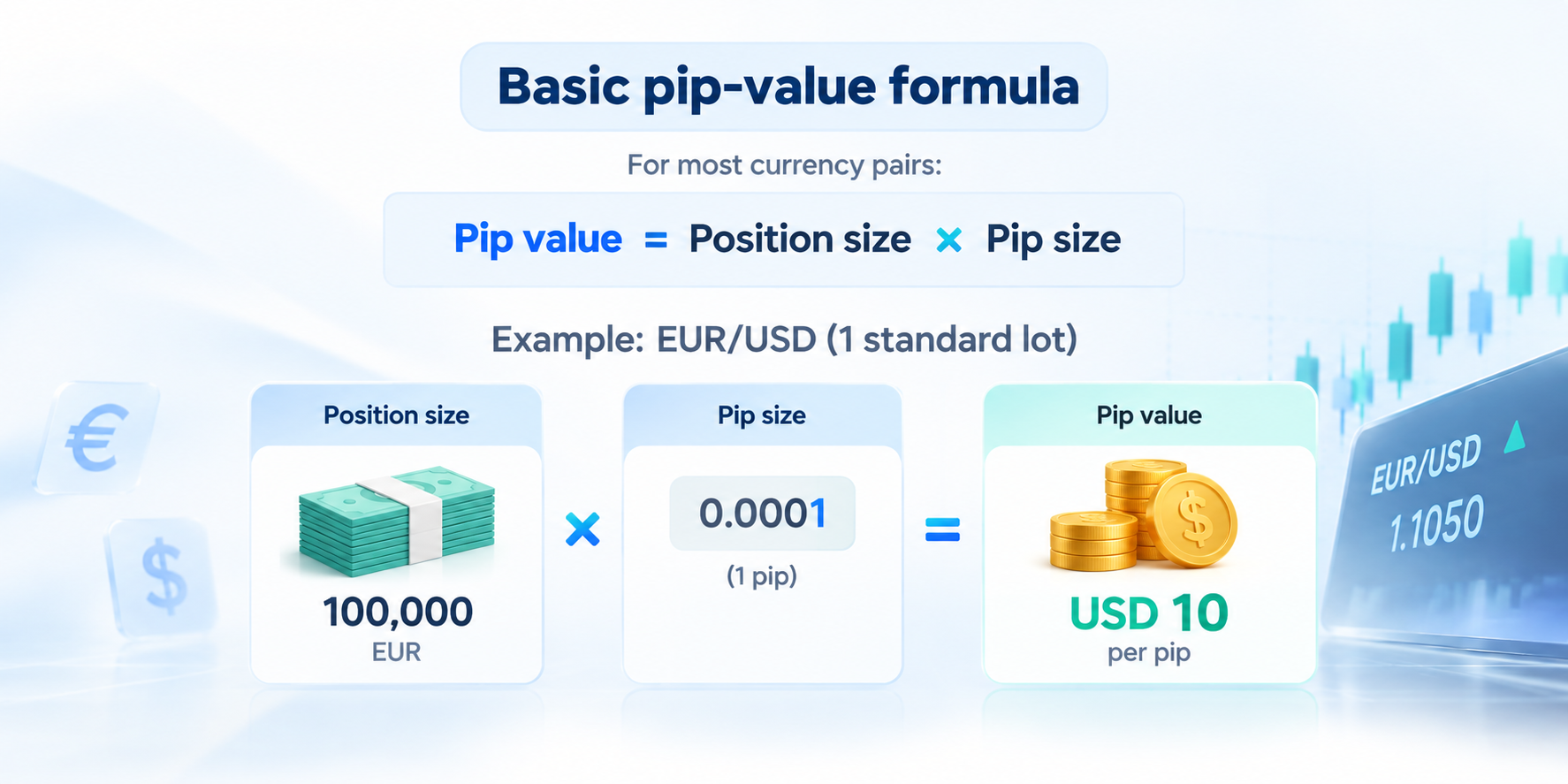
Therefore, a one-pip movement in a hypothetical 1-lot EUR/USD position represents approximately USD 10, assuming the account is denominated in USD.
The same calculation can be scaled down for smaller positions:
|
Position size |
Approximate EUR/USD pip value |
|
1.00 lot |
USD 10 per pip |
|
0.10 lot |
USD 1 per pip |
|
0.01 lot |
USD 0.10 per pip |
These figures are hypothetical examples, not a statement of the trading conditions or contract specifications available on any particular account.
How to Calculate Pips
Calculating the number of pips between two prices is usually simple once the pip size for the currency pair is known.
Example 1: EUR/USD
· Suppose EUR/USD moves from: 1.1050 → 1.1085
· The price difference is: 1.1085 − 1.1050 = 0.0035
· For EUR/USD, one pip is 0.0001: 0.0035 ÷ 0.0001 = 35 pips
· The hypothetical move is therefore 35 pips.
Example 2: GBP/USD
· Suppose GBP/USD moves from: 1.2700 → 1.2665
· The difference is: 1.2700 − 1.2665 = 0.0035
· Again, dividing by 0.0001 gives: 35 pips
· Because the price moved lower, this represents a 35-pip decline.
Example 3: USD/JPY
JPY pairs generally use a different pip convention.
· Suppose USD/JPY moves from: 150.20 → 150.65
· The price difference is: 150.65 − 150.20 = 0.45
· For USD/JPY, one pip is 0.01: 0.45 ÷ 0.01 = 45 pips
· The hypothetical move is therefore 45 pips.
How to Calculate Pip Value for Different Lot Sizes
Lot size determines how much each pip is worth.
A standard lot is commonly defined as 100,000 units of the base currency. A mini lot represents 10,000 units, while a micro lot represents 1,000 units.
For a hypothetical EUR/USD trade with USD as the account currency:
· 1 standard lot: 100,000 × 0.0001 = USD 10 per pip
· 0.10 lot: 10,000 × 0.0001 = USD 1 per pip
· 0.01 lot: 1,000 × 0.0001 = USD 0.10 per pip
This relationship means that increasing position size increases the monetary impact of each pip.
For example, a 50-pip move would represent approximately:
|
Position size |
Approximate value of 50 pips |
|
1.00 lot |
USD 500 |
|
0.10 lot |
USD 50 |
|
0.01 lot |
USD 5 |
These calculations assume EUR/USD and a USD-denominated account. They are hypothetical educational examples and do not account for spreads, commissions, swaps, execution differences or other trading costs.
What Is a Pipette?
A pipette is a fractional pip, usually one-tenth of a pip.
For example, a EUR/USD quote might be displayed as:
1.10500
If the fifth decimal place represents a fractional pip, a movement from 1.10500 to 1.10501 is one pipette, or 0.1 pip.
Therefore:
10 pipettes = 1 pip
The same principle can apply to JPY pairs when prices are quoted to an additional decimal place. Because quotation conventions can differ between instruments and platforms, traders should use the instrument's displayed precision when interpreting very small price changes.
Pip vs Pipette: What Is the Difference?
The distinction is mainly about the size of the price movement.
|
Term |
Typical meaning for non-JPY pairs |
Example |
|
Pip |
0.0001 |
1.1050 → 1.1051 |
|
Pipette |
0.00001 |
1.10500 → 1.10501 |
For JPY pairs, the conventional pip size is generally 0.01 rather than 0.0001.
This additional precision can help traders describe smaller price movements. Nevertheless, a pipette should not be confused with a full pip when calculating potential profit, loss or trading costs.
How Do Pips Affect Profit and Loss?

The number of pips a currency pair moves is only one part of a profit-and-loss calculation.
A simplified hypothetical calculation is:
Profit or loss = Number of pips × Pip value
For example, assume a trader holds a hypothetical 1-lot EUR/USD position and the pair moves 30 pips in the trader's direction.
If one pip is worth approximately USD 10:
30 × USD 10 = USD 300
The hypothetical result would be USD 300 before applicable trading costs.
If the same position moved 30 pips against the trader, the corresponding hypothetical loss would be approximately USD 300 before applicable costs.
Actual results can differ because the final monetary value depends on the instrument, position size, account currency, exchange rates and applicable trading costs. Leverage can also increase the size of both gains and losses relative to the capital committed.
How Do Pips Relate to Spreads?
The spread is the difference between the bid and ask prices of a currency pair. It is commonly expressed in pips.
For example, if a hypothetical EUR/USD quote has:
- Bid: 1.1050
- Ask: 1.1052
The difference is:
1.1052 − 1.1050 = 0.0002 = 2 pips
The spread is therefore 2 pips in this example.
A smaller spread generally means a smaller price difference between the bid and ask. However, spread is only one component of trading costs, and actual costs depend on the account, instrument and market conditions.
For current instrument specifications, traders should refer to the relevant product information rather than relying on a general pip example. See Forex Trading with CPT Markets for the currently published information on forex instruments and specifications.
Pips, Risk and Position Size
Understanding pips is useful for risk management because traders can use a pip distance to describe how far an exit level is from an entry level.
For example, a hypothetical trade might have:
- Entry: EUR/USD at 1.1050
- Stop-loss: 1.1020
- Distance: 30 pips
If the hypothetical position were 0.10 lot and each pip were worth approximately USD 1, the 30-pip distance would correspond to approximately USD 30 before other costs.
This does not mean that a 30-pip stop-loss is appropriate for every strategy or account. Market volatility, position size, account equity, trading costs and the trader's own risk parameters all matter.
Likewise, a smaller number of pips does not automatically mean lower financial risk. A large position can make each pip significantly more valuable.
For beginners, understanding the relationship between pip distance, lot size and monetary exposure is therefore more useful than focusing on the pip number alone.
Traders can also practise trading in a CPT Markets Demo Account without using real funds.
Key Takeaways
- A pip is a standard unit for measuring forex price movements.
- For most currency pairs, one pip is 0.0001.
- For most JPY pairs, one pip is 0.01.
- Pip value depends on position size and currency conversion, not simply on the number of pips.
- A pipette is generally one-tenth of a pip.
- The same number of pips can produce different monetary outcomes when position sizes differ.
- Pip calculations are useful for understanding spreads, position exposure and hypothetical profit or loss.
Frequently Asked Questions
What does 1 pip mean in forex?
One pip is a standard unit used to measure a currency pair's price movement. For most currency pairs, one pip equals 0.0001. For currency pairs involving the Japanese yen, one pip is generally 0.01. The monetary value of one pip depends on the position size and account currency.
How much is 1 pip worth?
The monetary value of one pip depends on the currency pair, position size and account currency. For a hypothetical 1-lot EUR/USD position with a USD-denominated account, one pip is approximately USD 10. Smaller positions have proportionally smaller pip values, although currency conversion may be required for other account currencies.
How do I calculate pips in forex?
First, identify the conventional pip size for the currency pair. Then calculate the difference between the two prices and divide it by the pip size. For example, a move from 1.1000 to 1.1030 in EUR/USD equals 0.0030, or 30 pips.
What is the difference between a pip and a pipette?
A pip is the conventional unit used to measure a forex price movement, while a pipette is generally one-tenth of a pip. For example, when EUR/USD is quoted to five decimal places, 0.00001 represents one pipette and 0.00010 represents one pip.
How many pips is 0.0010?
For most non-JPY currency pairs, a 0.0010 price movement equals 10 pips because one pip is 0.0001. For example, a move from EUR/USD 1.1000 to 1.1010 represents 10 pips. The calculation differs for JPY pairs because their conventional pip size is 0.01.
Does a higher pip value mean higher trading risk?
Not by itself. Pip value indicates the monetary impact of each pip for a particular position, while overall risk also depends on position size, stop-loss distance, market volatility, account equity and trading costs. A larger position generally makes each pip worth more, increasing the monetary impact of the same price movement.
Risk note: Forex and other leveraged derivatives involve significant risk and may not be suitable for all investors. Product availability, trading conditions, leverage, costs and applicable protections vary by jurisdiction and CPT Markets entity.
